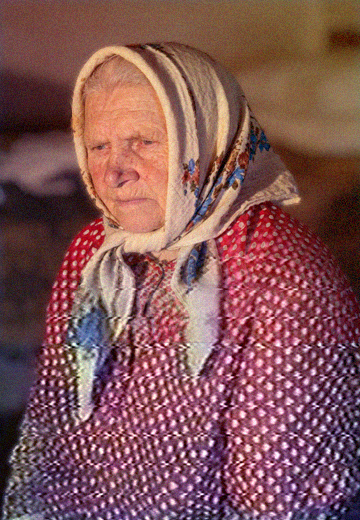
The Holodomor: Memories of the Tragedy of 1932–1933
1993, 69 min
Lviv Television, 1993. The documentary film “The Holodomor” tells the story of the 1932–1933 Holodomor in Ukraine and the assassination attempt by Mykola Lemyk on the Soviet consul in Lviv on October 21, 1933.
The film covers a conference on the Holodomor held in Canada in the fall of 1990, the causes and course of the mass famine of 1932–1933, and the Soviet authorities’ dispossession of the kulaks and repressions. Through eyewitness accounts, the film depicts the lives of Ukrainians during the Holodomor, the consequences of the famine, and the fates of those who survived it. It also examines the attempts by Polish and Soviet authorities to suppress information about the famine in Ukraine, as well as the aid that the Ukrainian community in Galicia sought to provide to the victims. A significant portion of the film is devoted to Mykola Lemyk, his family, and his activities within the Organization of Ukrainian Nationalists. It details his planning and execution of the assassination of the Soviet consul in Lviv, the trial, the protests by the Ukrainian public, and Ukrainian society’s reaction to the Holodomor and Stalinist repressions. Through the recollections of Mykola Lemyk’s relatives, the filmmakers recount his family life, his imprisonment, his escape, his subsequent struggle, and the fate of his loved ones.
In the video: a university building in Canada, a poster about the Holodomor, conference participants and a speaker’s presentation, house No. 27, clippings from Polish newspapers, a photograph of Mykola Lemyk, the village of Solova in the Lviv region, rural landscapes, the Lemyk family’s house, girls in Ukrainian folk costumes holding a portrait of Taras Shevchenko, horsemen in a wheat field, photographs and footage from the time of the Holodomor, photographs of Mykola Khvylovy, Mykola Skrypnyk, and Mykola Stronsky, a Communist parade, a march of Red Army soldiers, portraits of Joseph Stalin, footage of executions, the demolition of church bell towers, mass graves, children who suffered from starvation, the building of the “Dnister” insurance company on Ruska Street in Lviv, issues of the newspaper “Dilo,” black-and-white footage from war newsreels, bombers, a plane crash, a tank, and military equipment after battle. The film incorporates excerpts from the movie “Harvest of Sorrow” and footage from newsreels.
Commentary by: Petro Duzhyi, member of the leadership of the Organization of Ukrainian Nationalists; Yulia Lemyk, sister-in-law of Mykola Lemyk; Iryna Tanchyna, niece of Mykola Lemyk; Lyubov Lemyk, wife of Mykola Lemyk; and Yaroslav Svatko, editor of the newspaper “Shlyakh Peremohy.”
The film was produced by: screenwriter Vasyl Hlynchak, director Oleg Andreyev, sound engineer Volodymyr Pavenskykh, cinematographers Marian Radomsky, Oleksandr Tsisyk, and Vasyl Hlynchak, still photographer Pavlo Sheremetev, production designer Vasyl Foremsky, and assistant directors Svitlana Sosnovska, Andriy Varshavsky, Romana Durnyak, and Tetiana Pryshanova; video editors Vitaliy Nefyodov, Serhiy Pyatov, and Andriy Shcherban; and editor Myroslav Skuratko.